LAB WORK
Below are studies, experiments, and visual thought forms: studio thinking made visible. Works that test a proposition, follow a logic to its limit, or hold two incompatible systems in the same frame to see what happens.
Neither preliminary nor separate. These are works that mattered - places where questions first emerged, changed form, or returned under new conditions.
COORDINATED COPYRIGHTS (2013–2016)
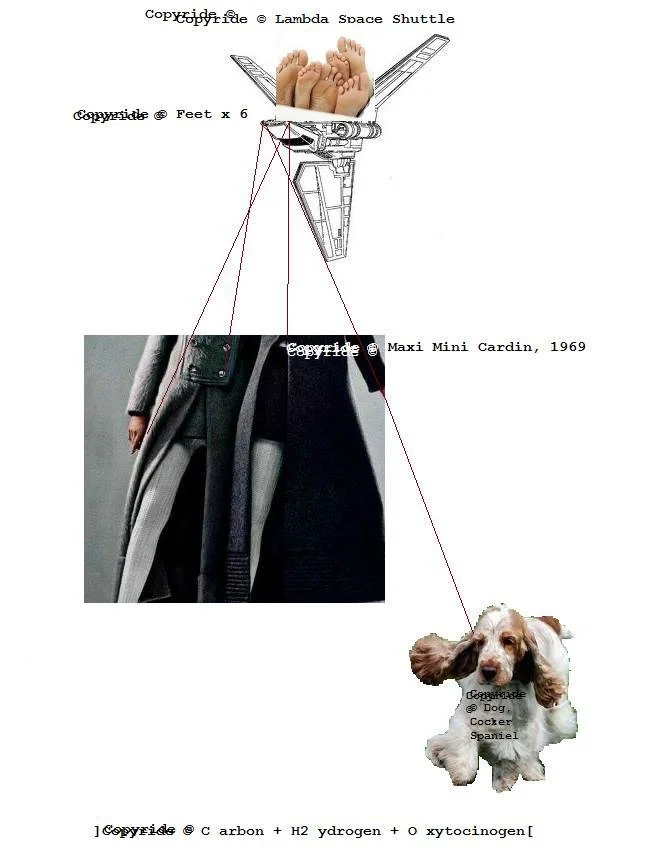
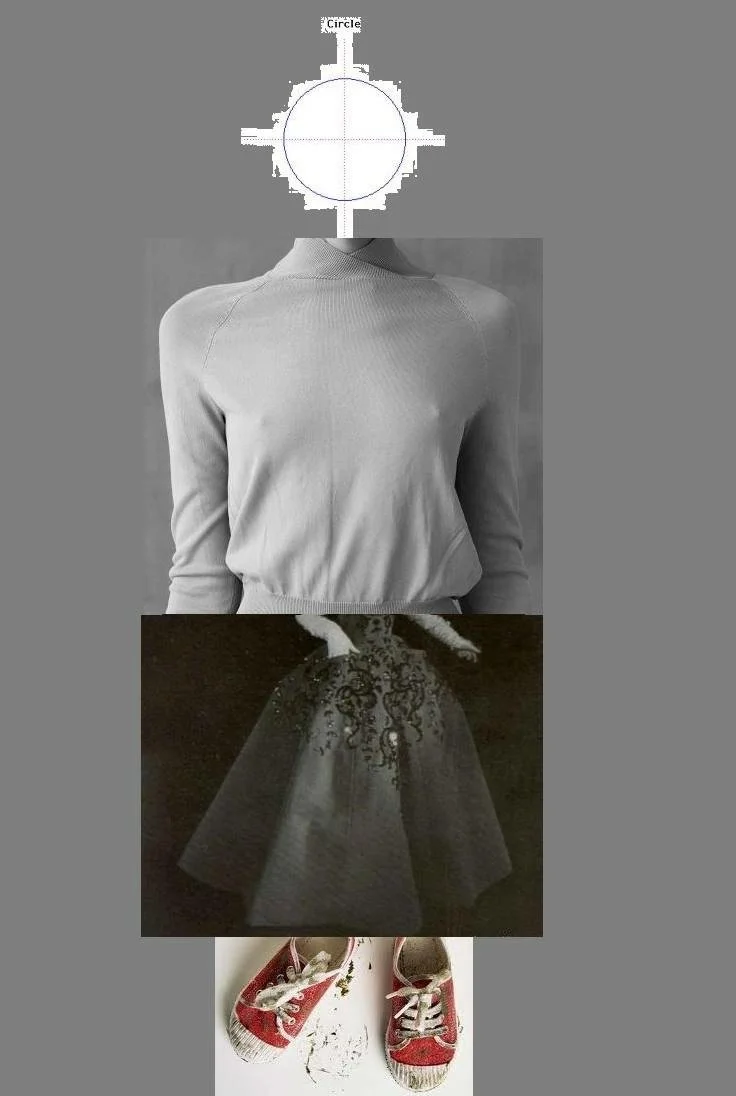
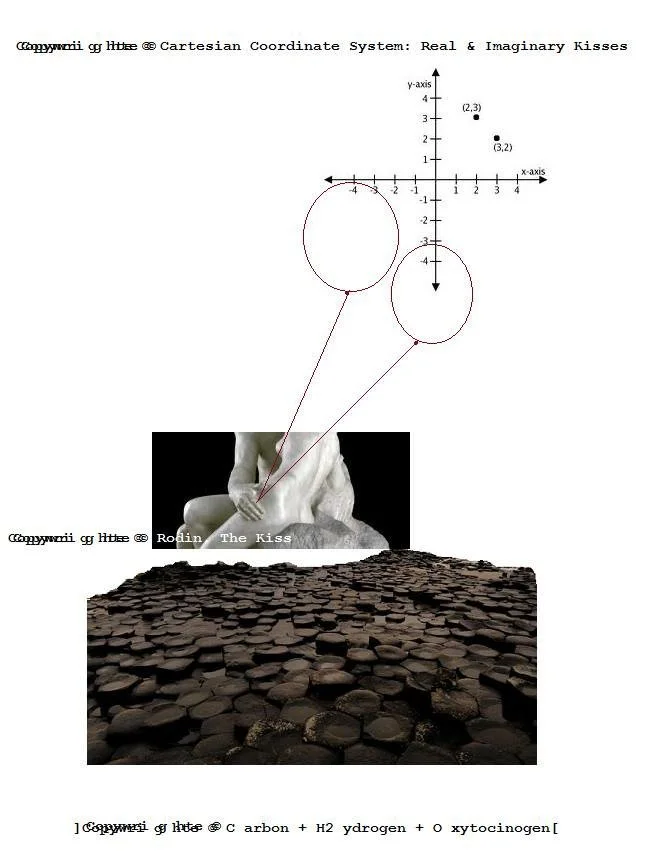
This series operate as a sustained investigation into ownership, authorship, and the construction of subjectivity through borrowed forms. The title itself performs a double movement. "Copyright" invokes legal protection, originality, and claims of possession; "coordinated" invokes geometry, mapping, and systems of relation. Together they suggest that identity is never singular but assembled through coordinates - historical, cultural, and symbolic.
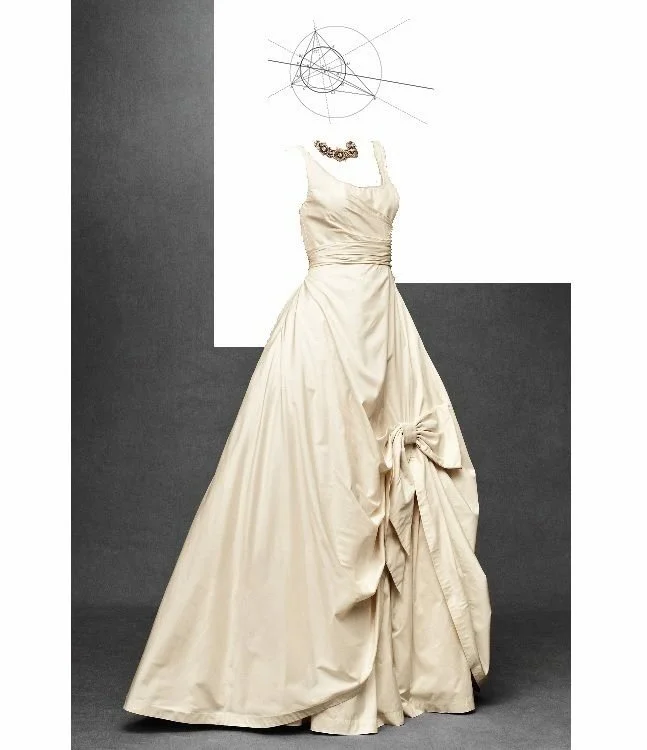
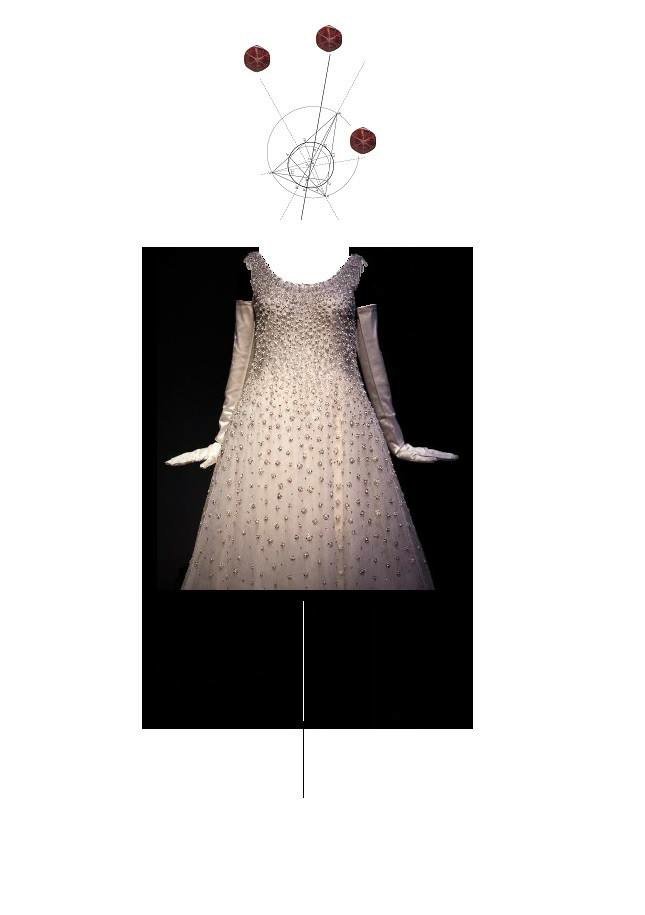
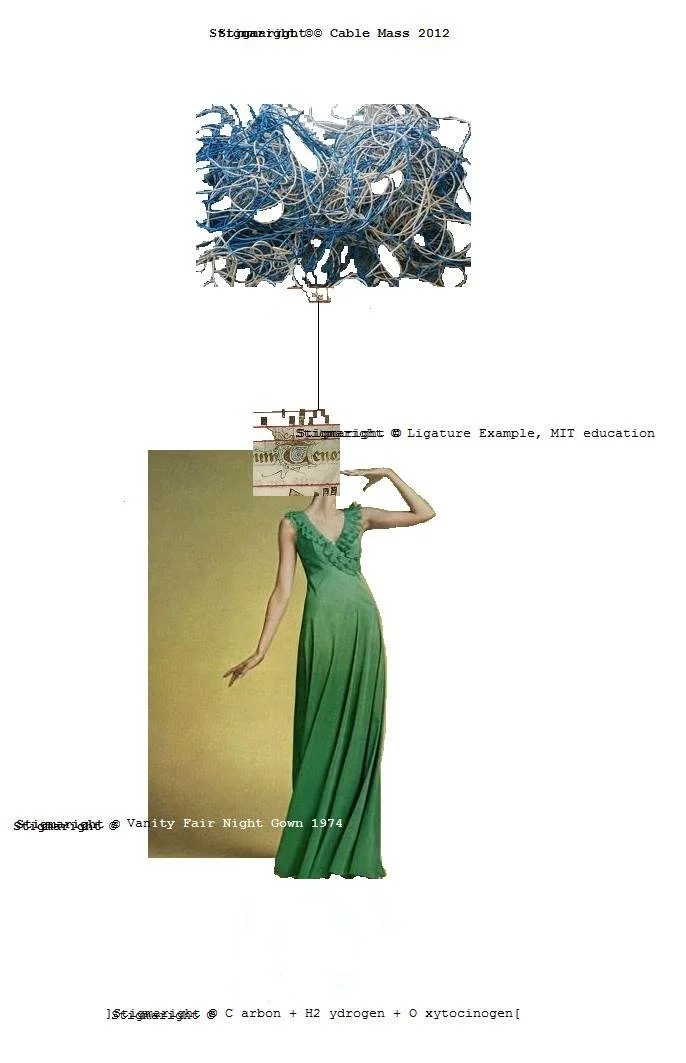
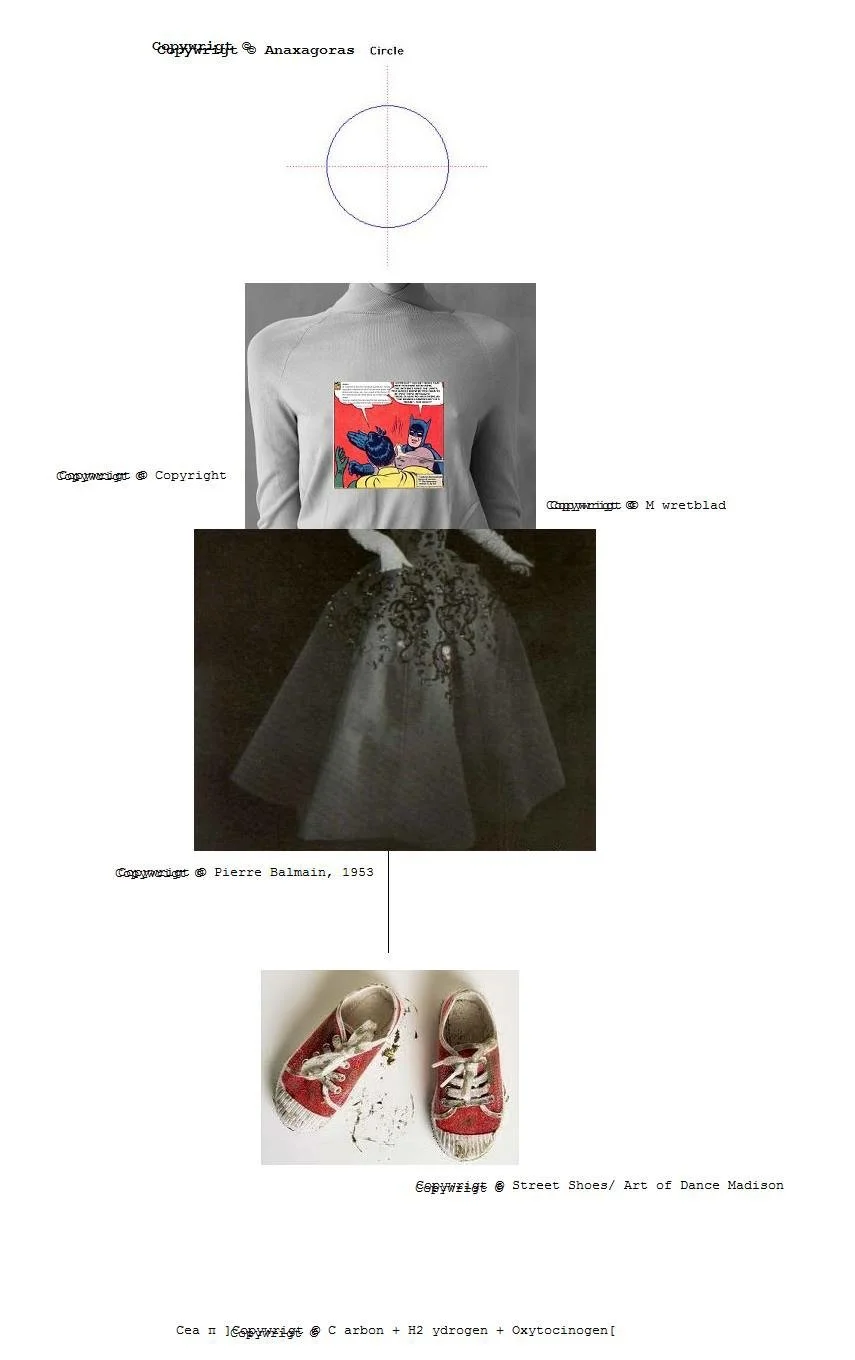
Across the series, images are arranged along a persistent vertical axis. Geometric diagrams occupy the upper register, garments and bodies the centre, while chemical or textual formulations appear below. The works read less as collages than as propositions: systems through which bodies become legible and culture organises itself.
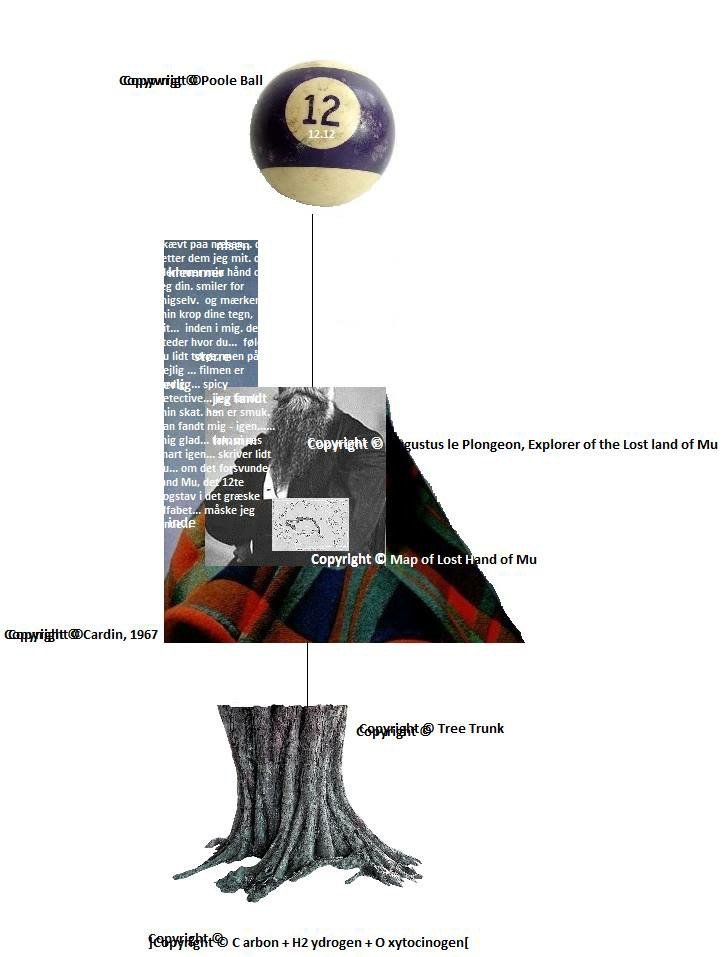
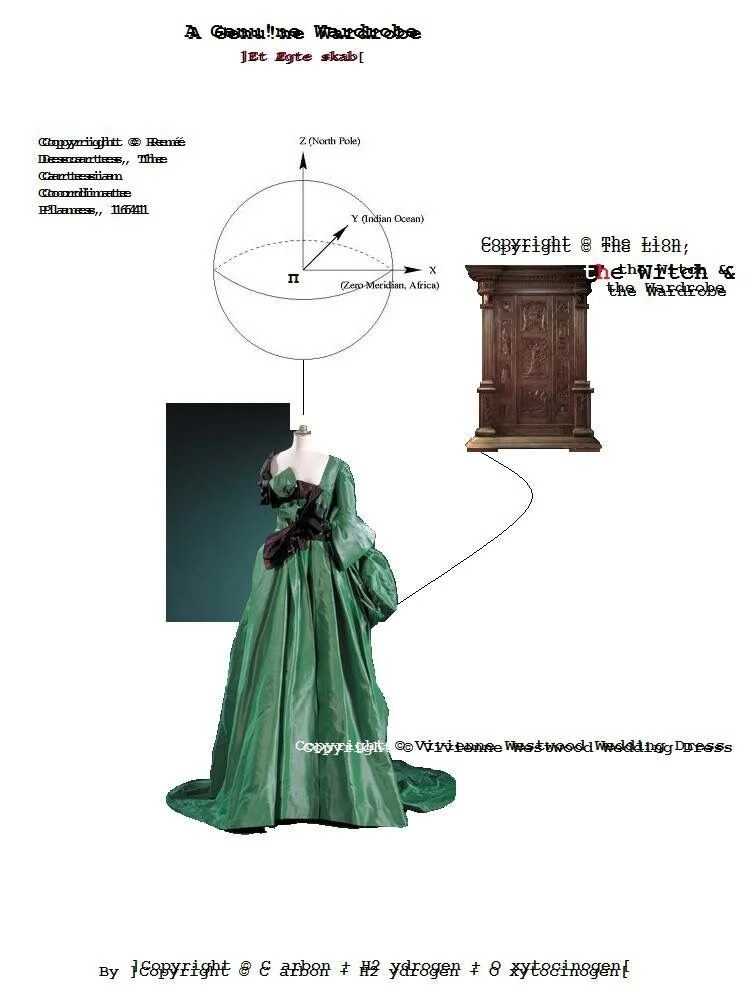
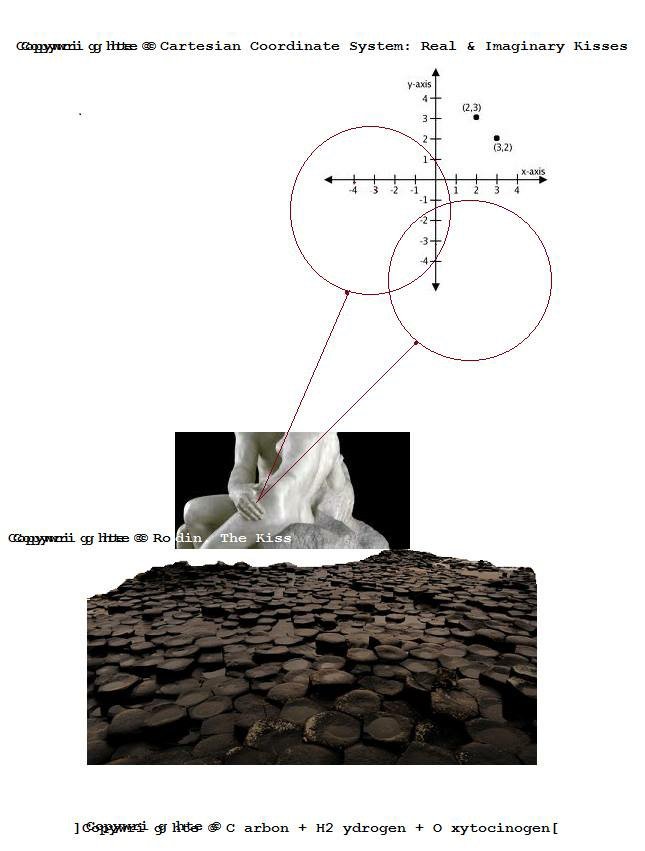
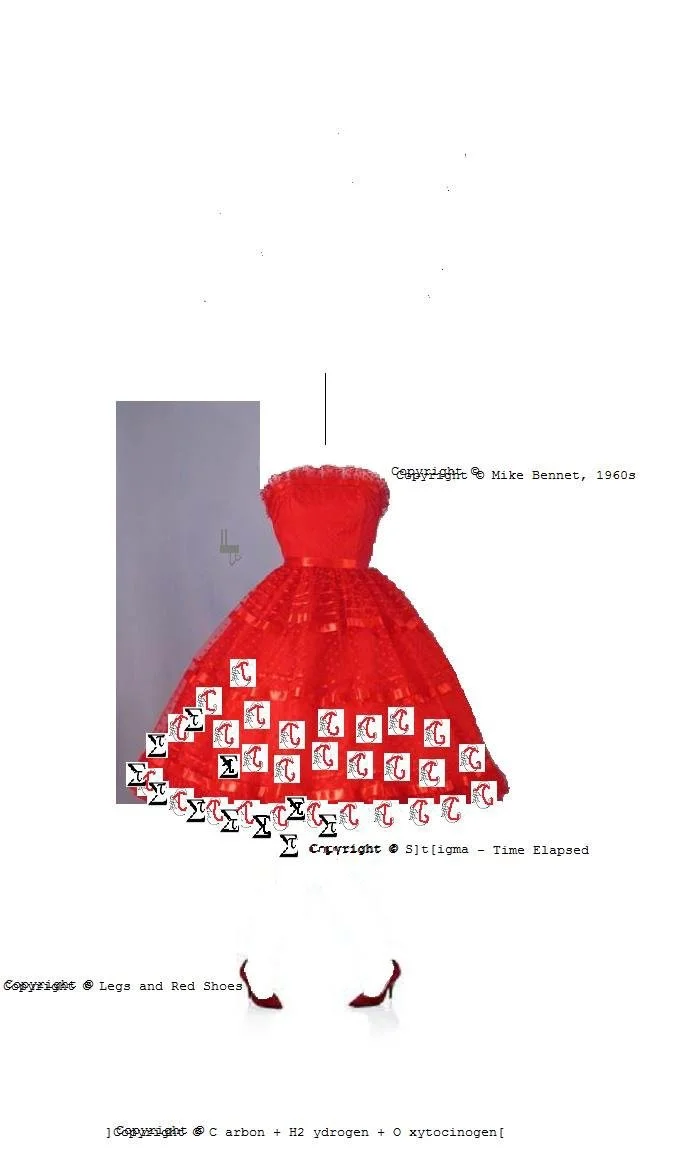
The repeated use of copyright notices is central to this structure. Rather than protecting images, the © sign becomes material in its own right. Through repetition it loses its legal transparency and becomes visible as a mark of power, attribution, and circulation. Every image is sourced; every image is borrowed. Fashion photography, mathematics, literature, geology, anatomy, mythology, and private writing are treated with the same archival status. No hierarchy remains between high culture and found material, between intimacy and citation.
Headlessness recurs throughout the series. Faces are replaced by circles, mirrors, coordinates, coins, diagrams, or fragments of text. Subjectivity is displaced into systems of measurement and representation. The absent face becomes the site where symbolic structures appear. Identity emerges not as portrait but as relation.
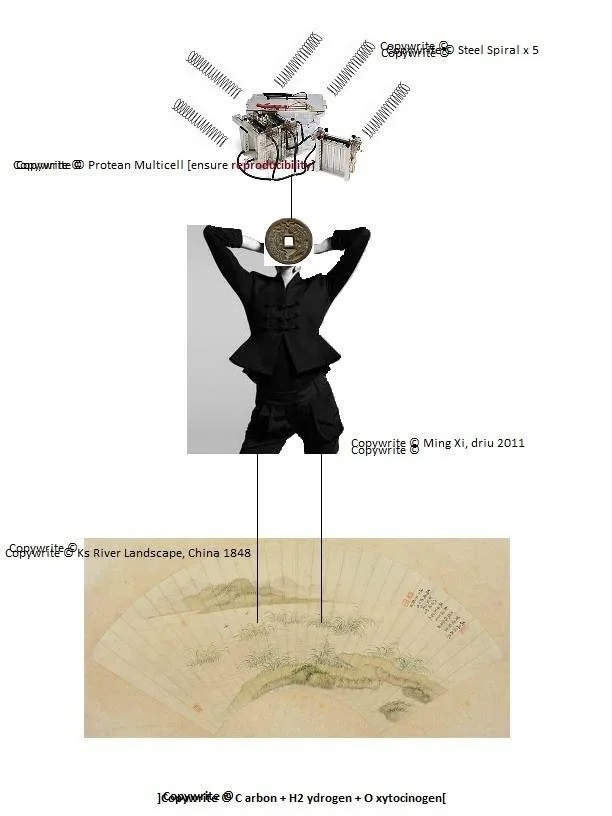
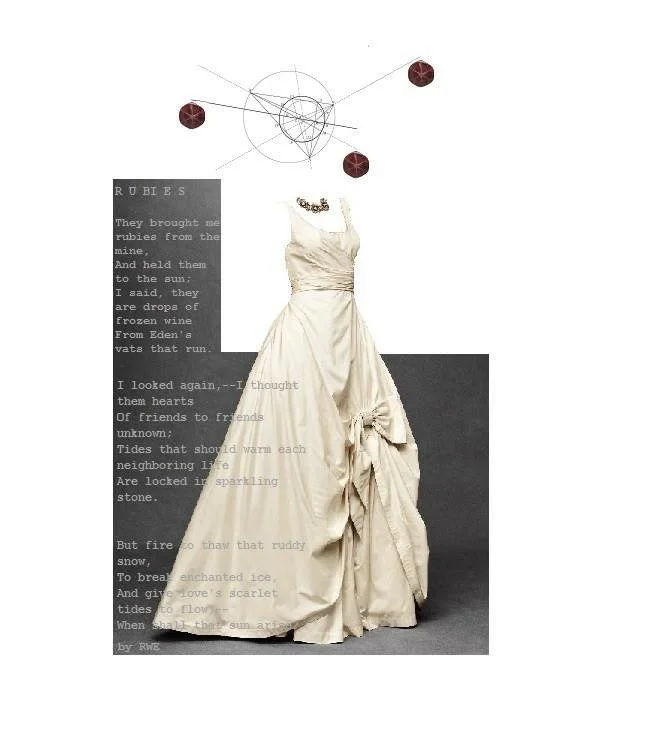
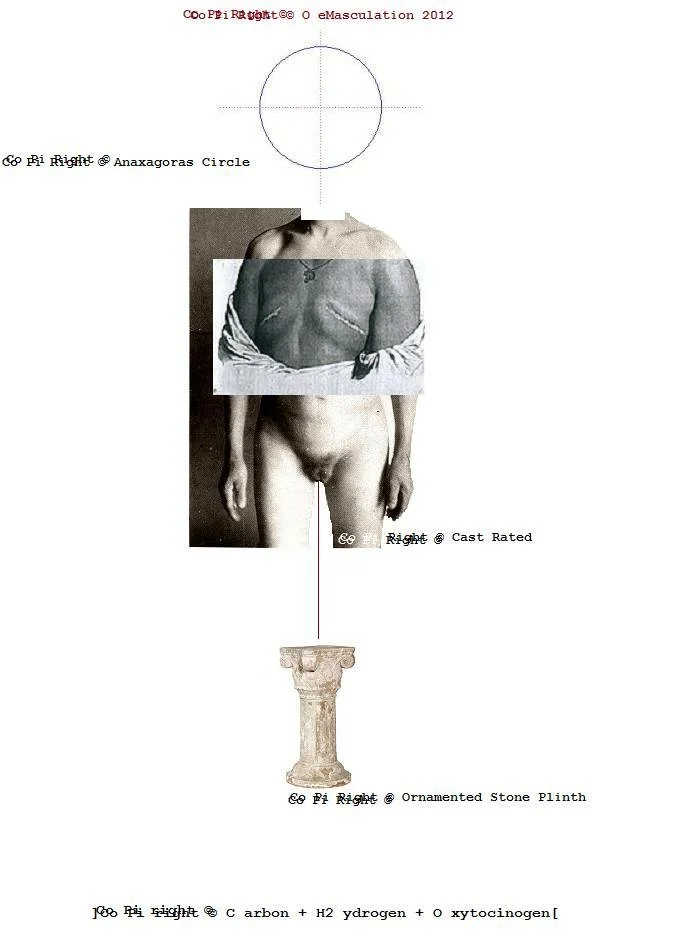
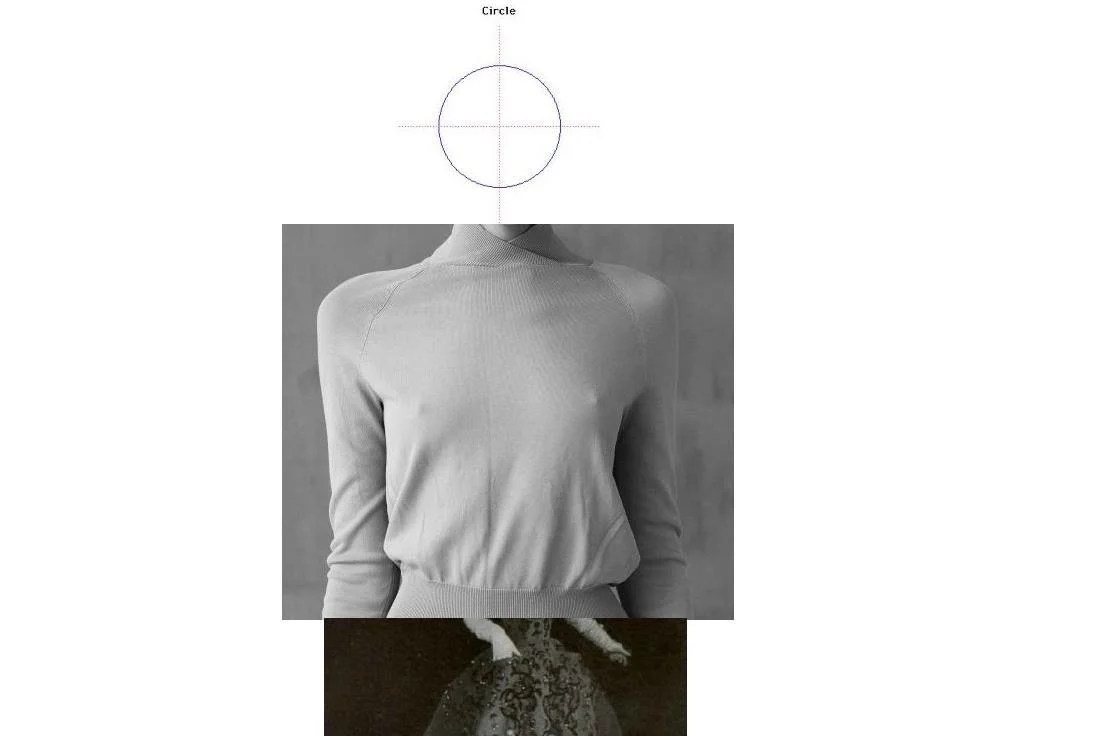
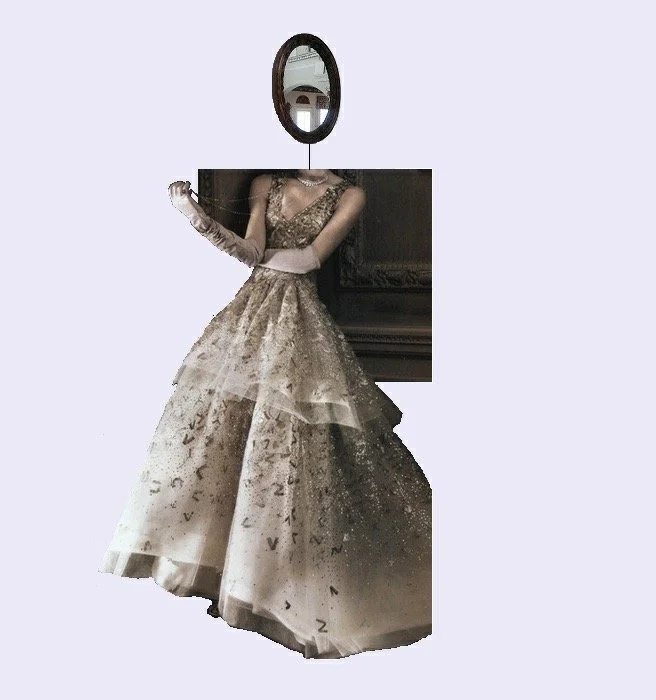
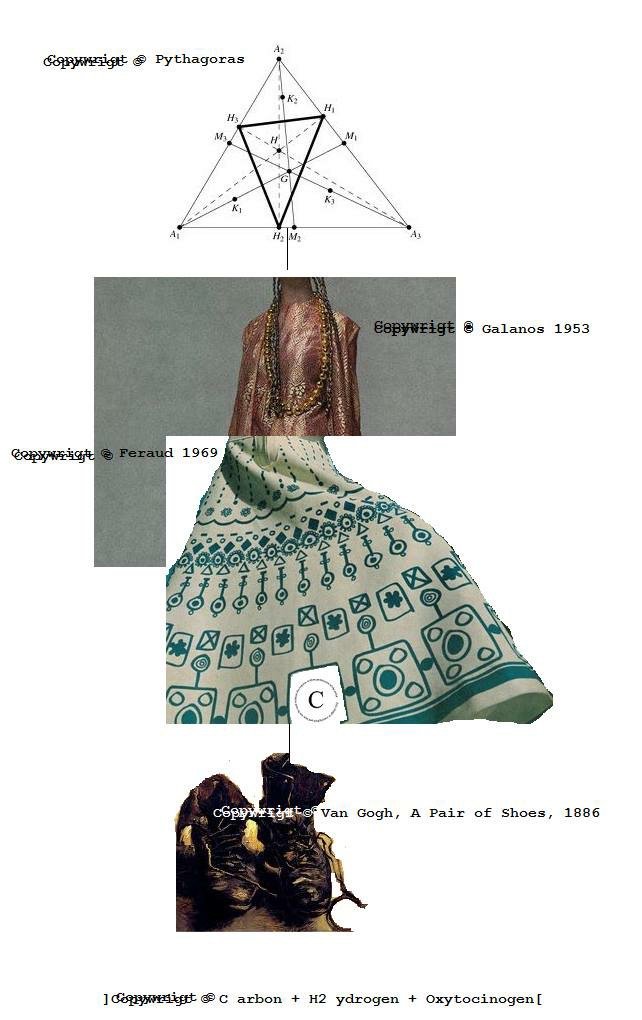
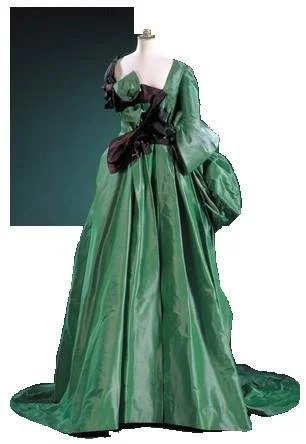
The fashion archive occupies a central role. Dresses, shoes, and garments from different decades appear detached from stable bodies, suspended between mannequin, memory, and citation. These historical forms of femininity are neither celebrated nor rejected; they function as carriers of cultural inscription. Clothing becomes an archive through which bodies are imagined, regulated, and inherited.
Mathematical figures recur with equal insistence: Cartesian coordinates, circles, geometric constructions, and spatial diagrams. These systems do not merely illustrate rational order; they intersect with intimacy, desire, and embodiment. Works such as Cartesian Coordinate System: Real & Imaginary Kisses suggest that affection itself may be mapped, measured, and abstracted, while remaining irreducible to those operations.
Throughout the series appears the recurring formula:
] C arbon + H₂ ydrogen + O xytocinogen [
Part chemistry, part neologism, part poetic fragment, the notation remains open rather than resolved. It suggests that attachment and relation may have material substrates while exceeding scientific language. The bracket never fully closes.
Mathematical figures recur with equal insistence: Cartesian coordinates, circles, geometric constructions, and spatial diagrams. These systems do not merely illustrate rational order; they intersect with intimacy, desire, and embodiment. Works such as Cartesian Coordinate System: Real & Imaginary Kisses suggest that affection itself may be mapped, measured, and abstracted, while remaining irreducible to those operations.
Seen from the present, these works appear strikingly prescient. Produced before contemporary debates around generative AI and dataset culture, they already ask what it means to create from borrowed images, inherited forms, and collective archives. The works do not oppose originality and reproduction; rather, they propose that subjectivity itself is composed through acts of citation.
In this sense, COORDINATED COPYRIGHTS is not simply a reflection on image ownership. It proposes a broader condition: that selves, like images, emerge through networks of relation, attribution, and exchange. Copyright is coordinated because culture is coordinated, and because identity itself is assembled from what has already been given.
©️ Camilla Howalt
2002-2009
This period unfolded largely outside exhibition structures. While large-scale installation work receded, artistic inquiry continued through drawings, notebooks, ink works on paper, and material experiments developed alongside everyday life and the raising of children.
These years brought a fundamental shift in the experience of time, labour, repetition, and attention. Rather than constituting a break in the practice, they altered its conditions. Many works from this period remain dispersed, archived, or are only now being rediscovered and added to LAB WORK.
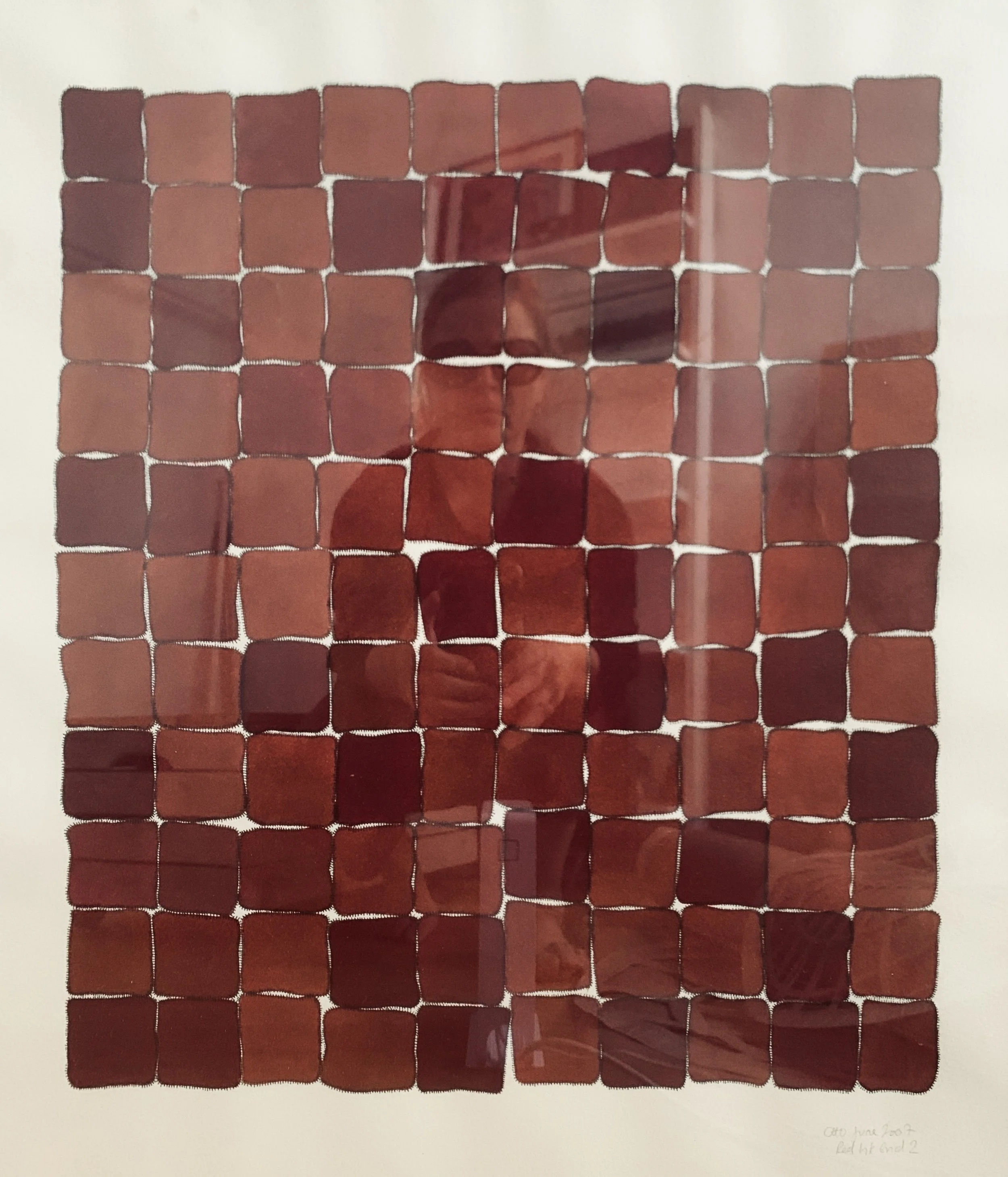
The raising of children was itself a profound creative undertaking, reshaping both life and the circumstances under which art could be made. Artistic thinking persisted in smaller and more intimate formats, where questions of emotional space, structure, materiality, and relation continued to evolve.
From around 2007 onwards, the first felt grids began to emerge, introducing a language of seriality, accumulation, and textile structure that would become central to later work.
LAB WORK gathers these studies, fragments, and transitional works as part of a continuous artistic trajectory in which finished works and preliminary investigations coexist.
©️ Camilla Howalt
PARTING (2002)
Installation
Felt / Concrete / Perspex / Raw Sheep Wool / Gloss Household Paint
6 × 5 m
Juxtaposition forms the foundation for the formal and emotional relationships between materials and the choreographed arrangement of objects. This project concerns emotional breathing spaces—or the lack of them. What unfolds in the surrounding space is a fragmented externalization of the figure’s emotional reality, where the Other is experienced as outside oneself rather than within. In this way, the Other becomes a kind of roadmap, carrying both projection and desire, pointing toward the possibility of awareness.
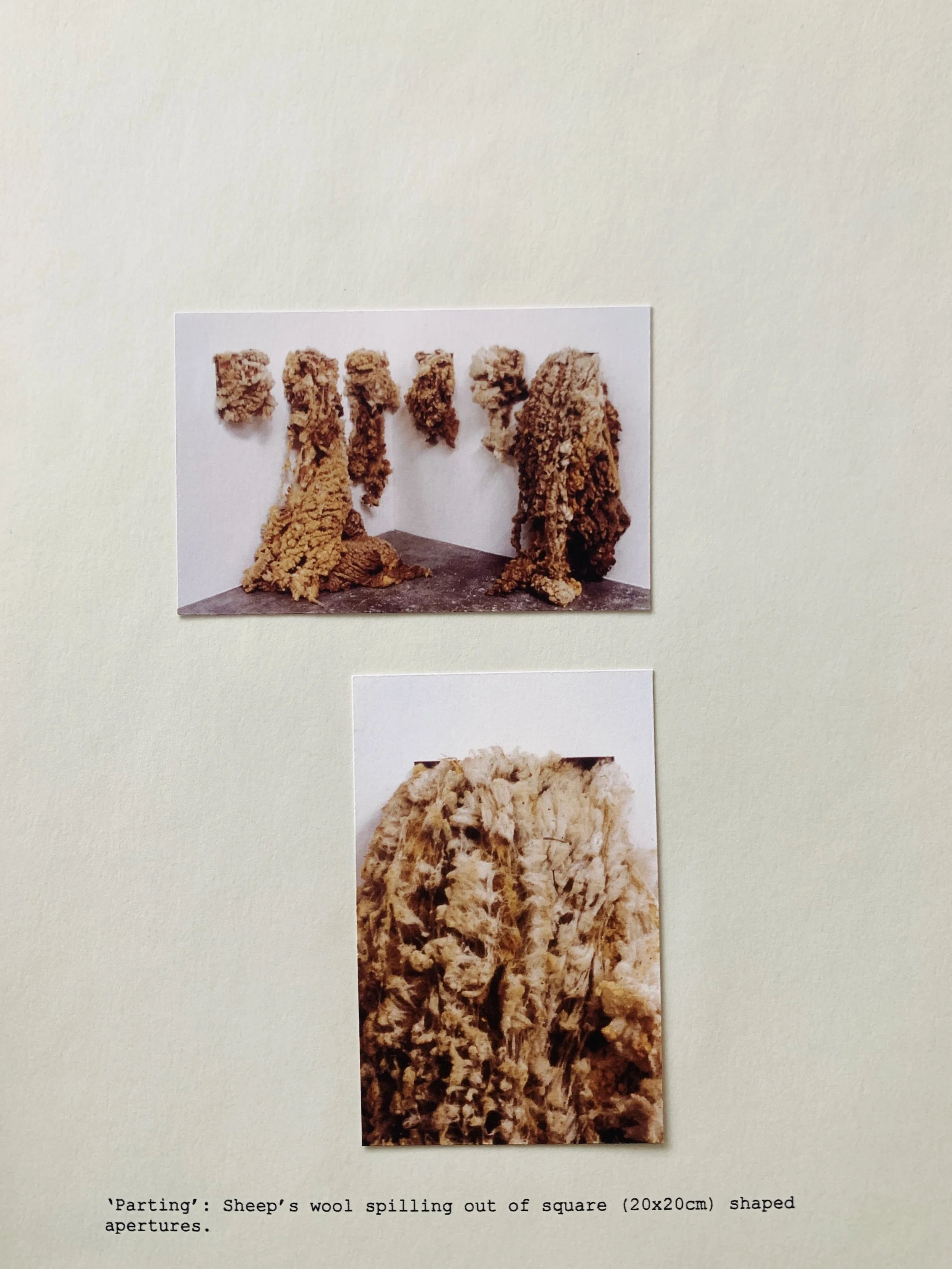
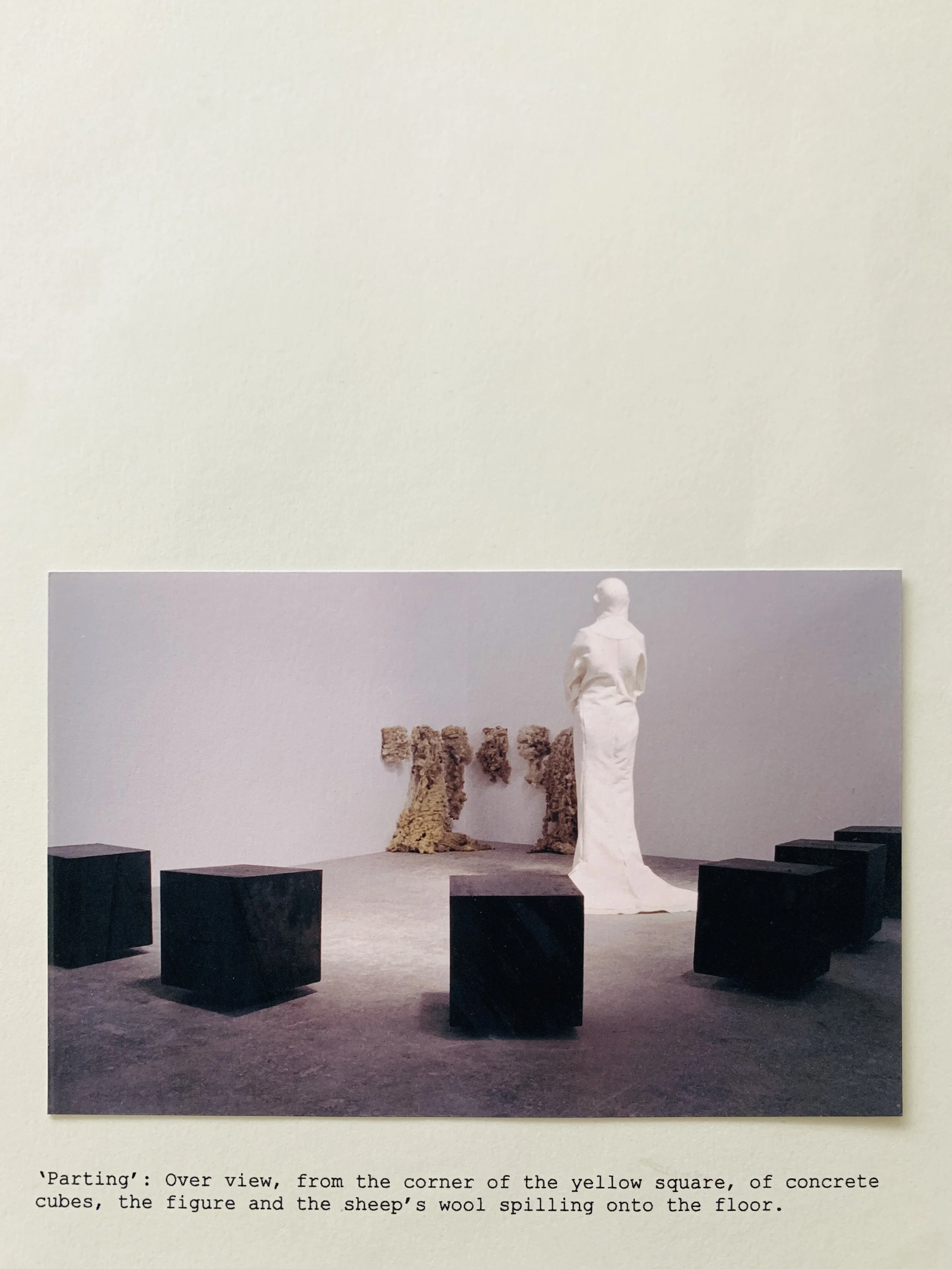
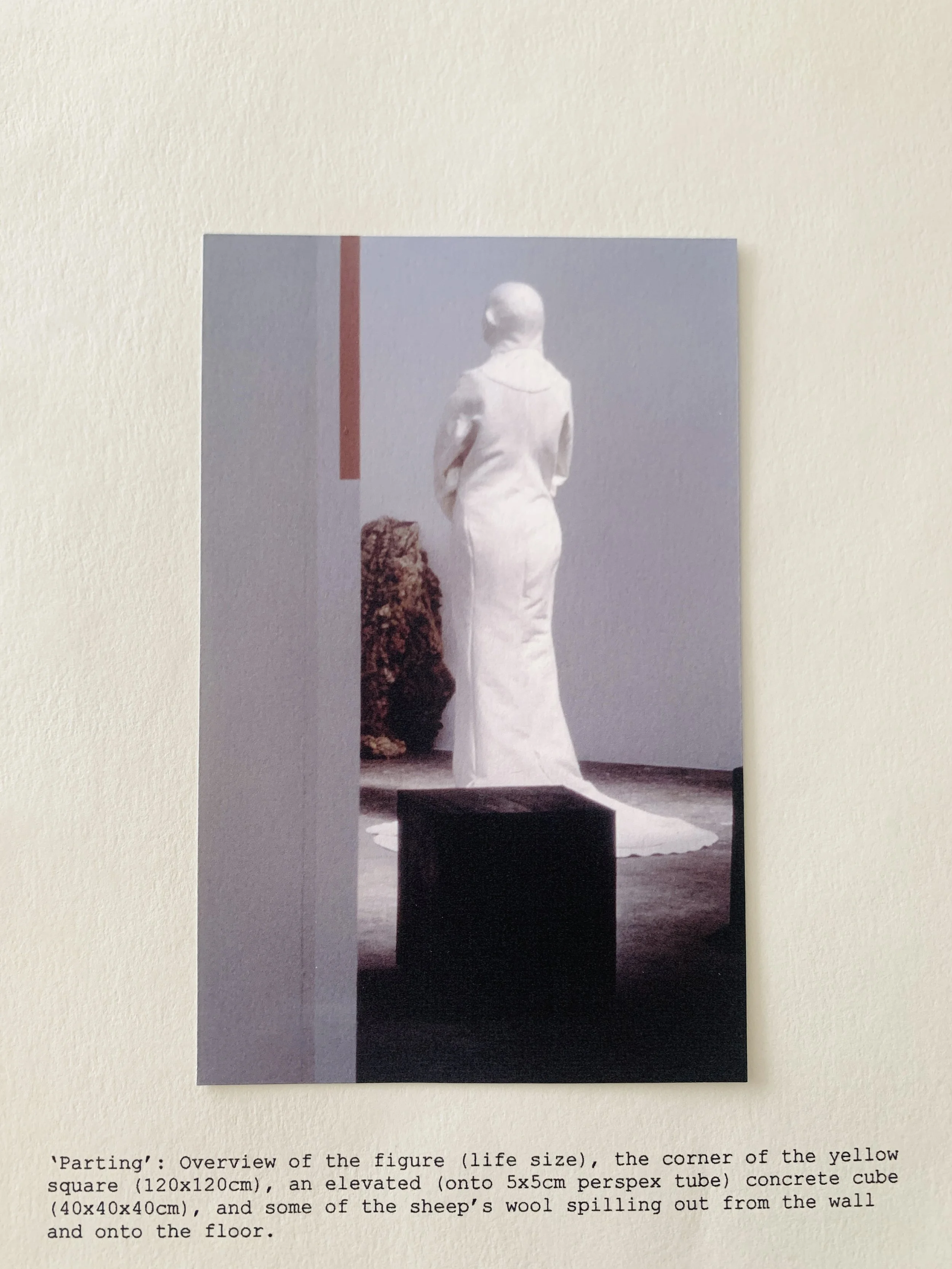
The figure itself is majestic and faceless, suspended in a straightjacket dress that hovers like a wedding gown—a presence at once solemn and constrained. Around it, adjoining structures echo this tension: cube-shaped forms in solid concrete float upon cylinder-shaped perspex rings; quadrant frames are cut open, through which raw sheep’s wool, spiders, and all that once lived from the sheep spill downward like gashes or waterfalls. The wall behind holds an impenetrable yellow square painted in dense gloss household paint, creeping slightly around the corner to invite a sense of immersion.
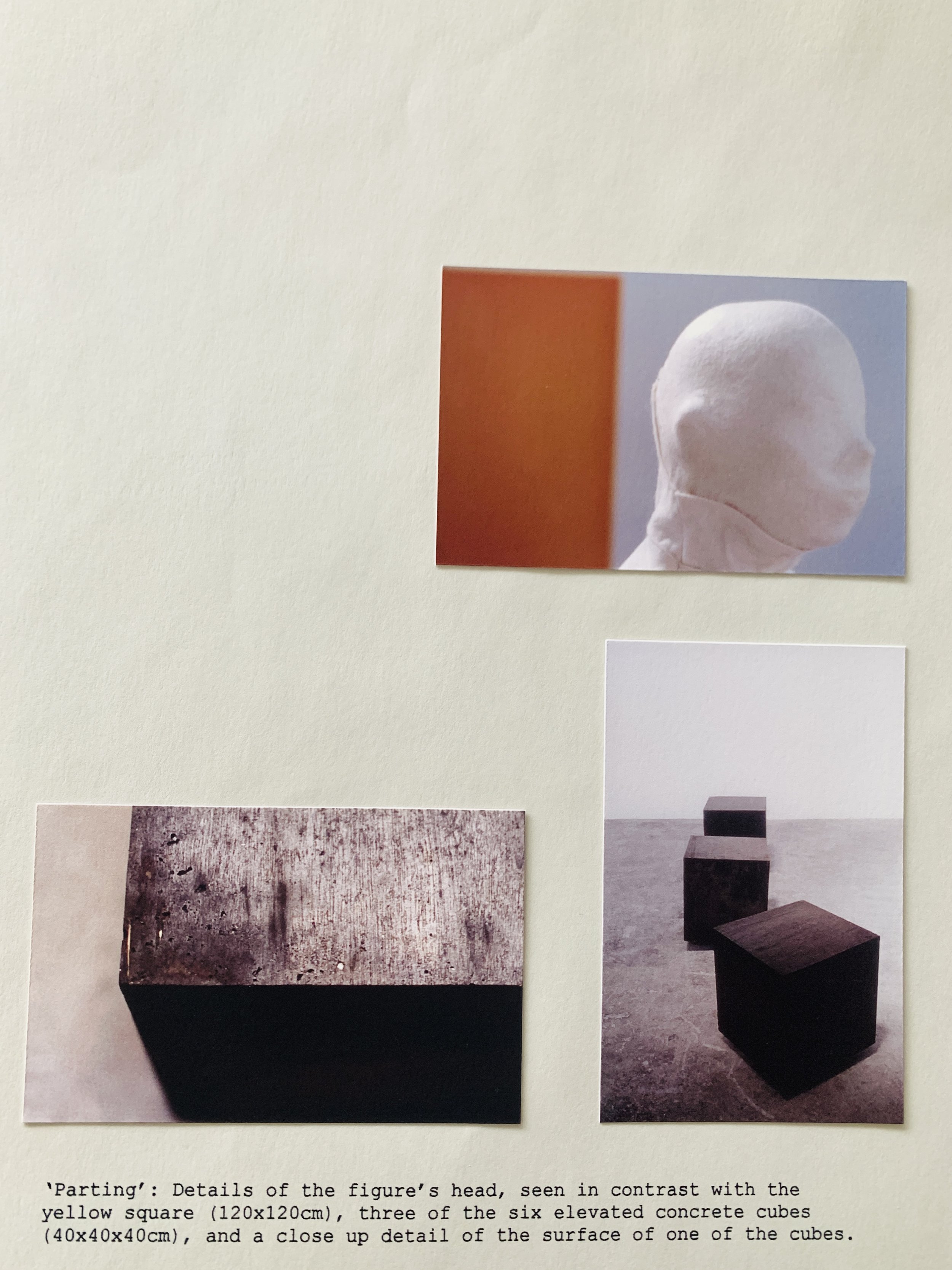
Breathing spaces here are dense, congested, and exploited. The figure appears sealed off, existing only within itself, and this stalled existence reverberates outward, mirrored in the density and overflow of materials. A fragile balance is maintained, as if the viewer were suspended inside a still image taken from a moving camera.
©️ Camilla Howalt
DERIVATION (2001)
Installation
2 x wall to wall carpet in ivory & steel grey / Cotton string / Felt / Red House hold paint / MDF / Photography / Electrical light bulb / Audio scape
2 rooms of app 5 × 5 m
By enforcing the combination of several elements within one piece, I have looked to artists in various fields. To name a few: Tadao Ando, the Japanese architect, whose architecture offers serenity and a stillness that I myself seek and long for within art and life, has inspired my thinking about placement and the juxtaposition of otherwise abstracted objects. At the other end of the emotional scale, Rainer Maria Rilke, the German poet who wrote the Duino Elegies, gave me a sense of courage to explore the nature of emotional implosion.
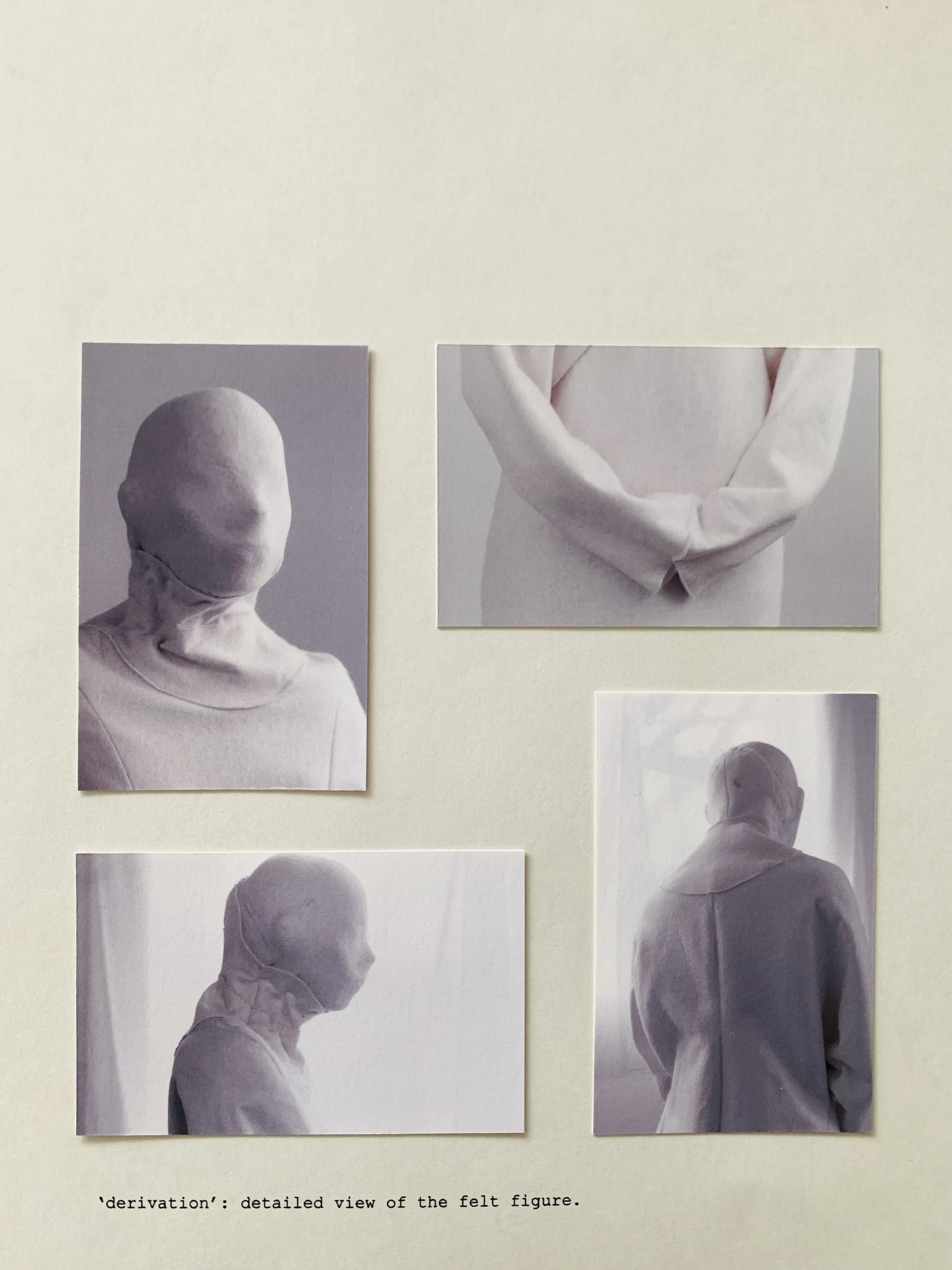
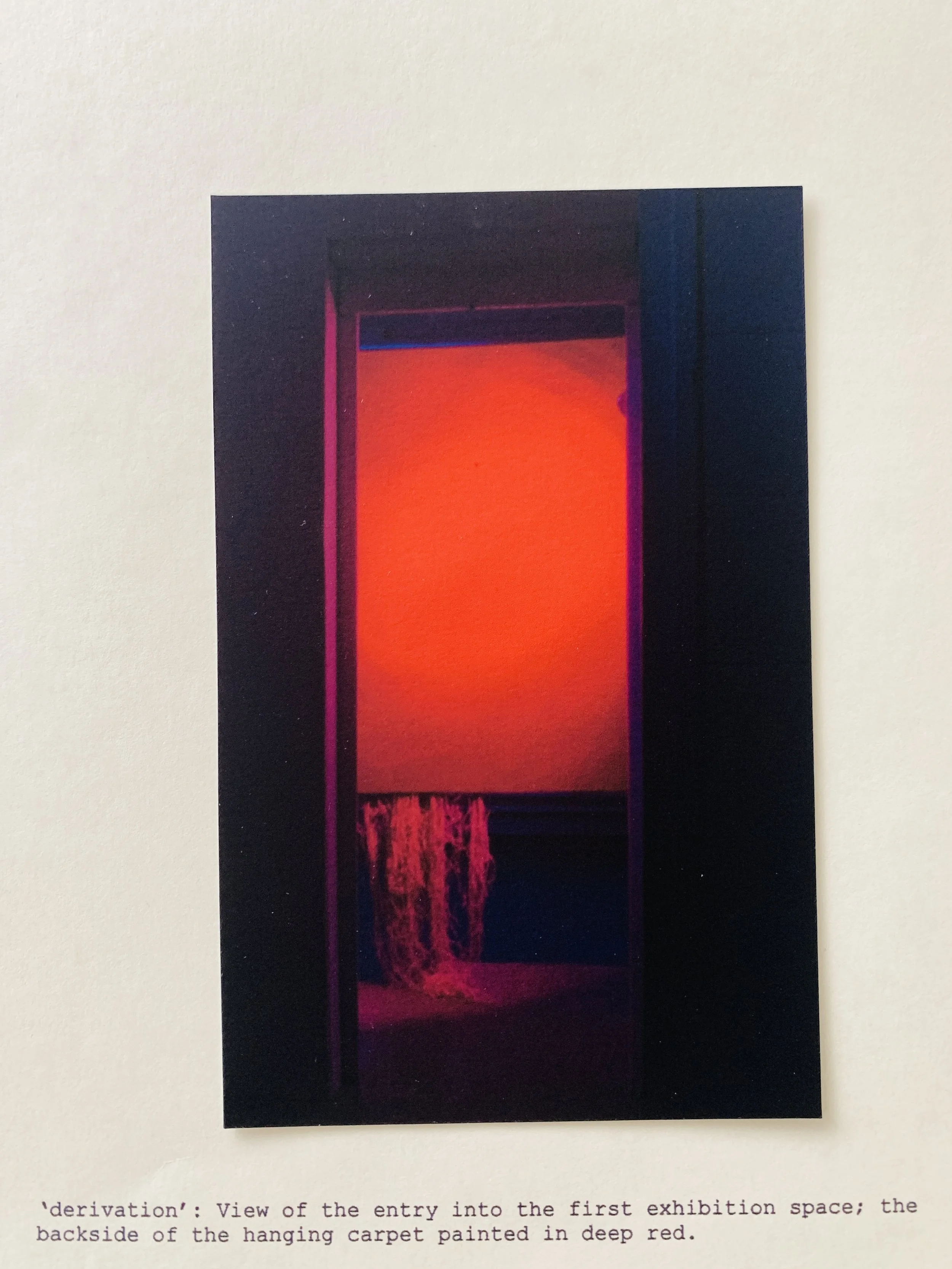
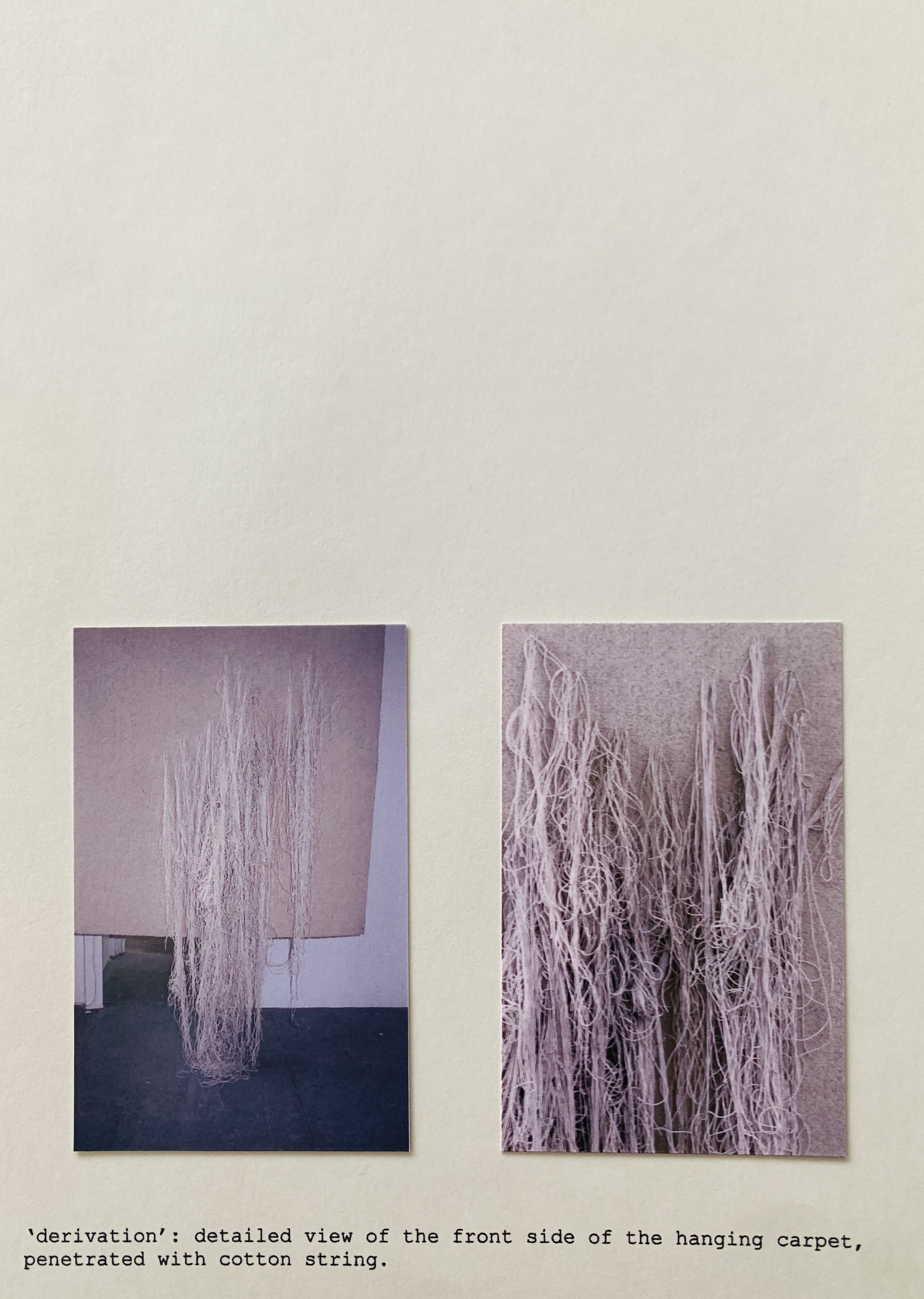
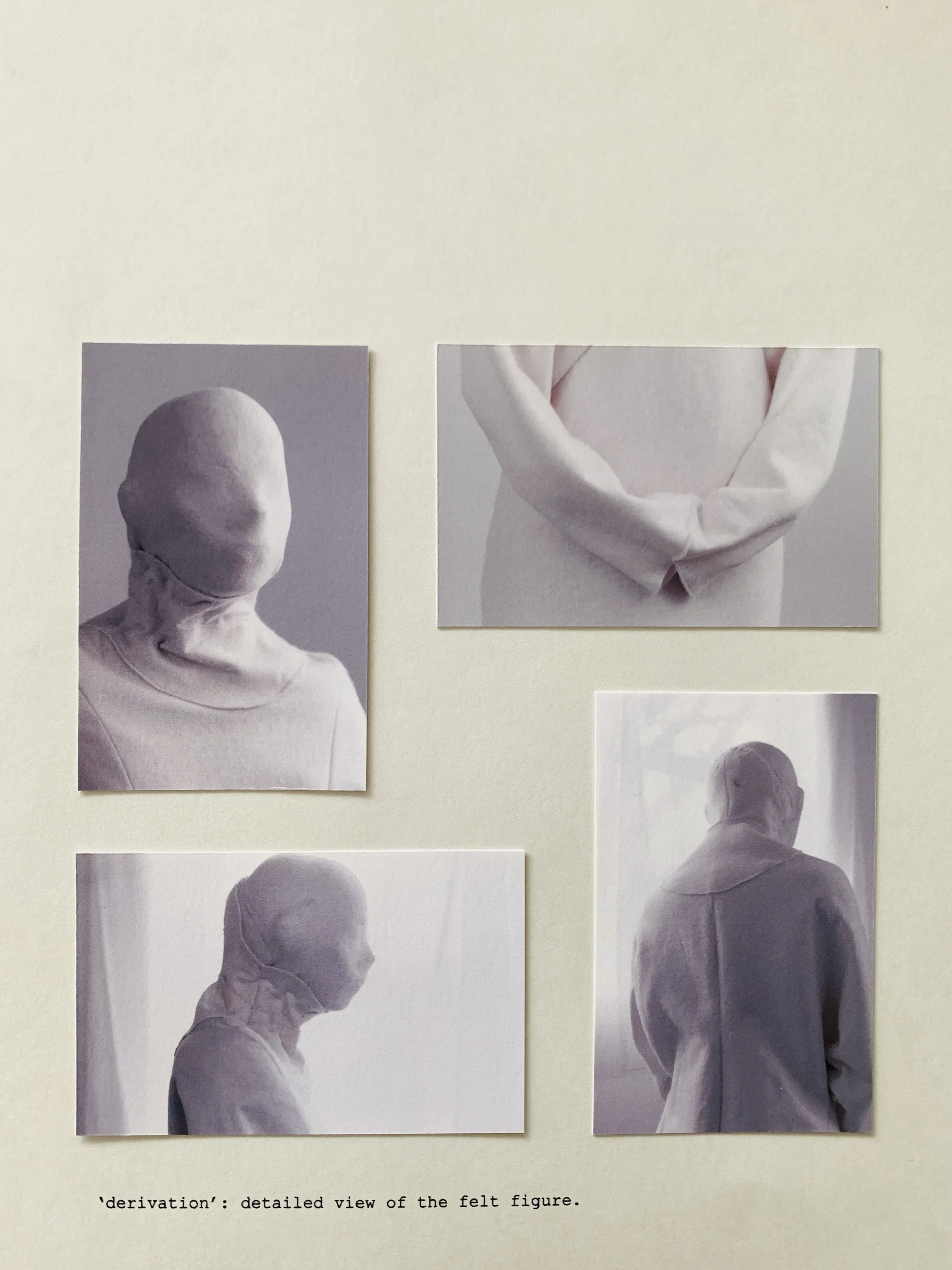
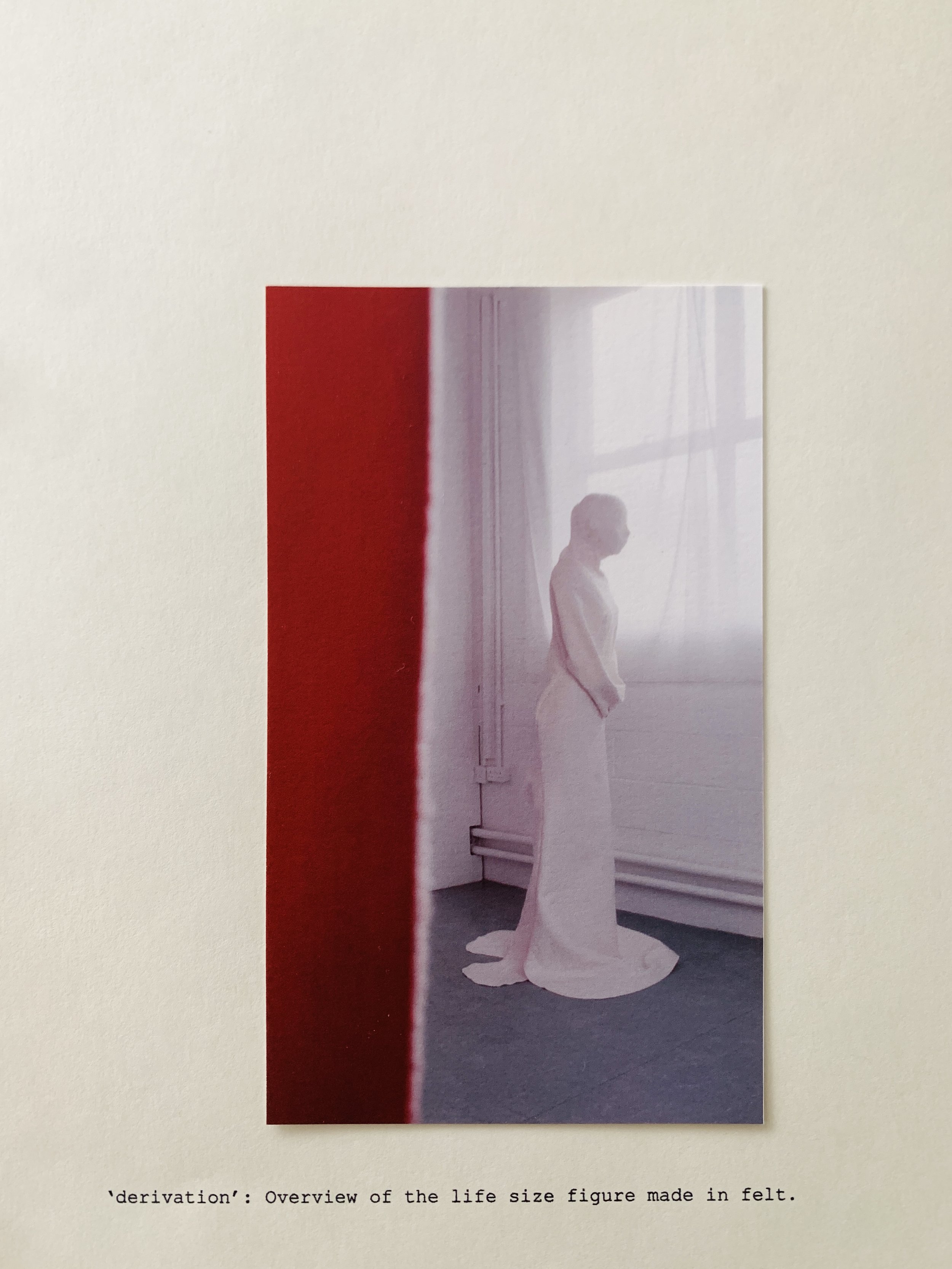
Derivation is comprised of three main elements divided between two rooms. In the first room, one enters a space illuminated in red light, created by the backside of a carpet painted deep red and hung one metre inside the installation entrance, creating a corridor through which the viewer must pass. Upon entering the space, the viewer encounters the back of a solitary life-size female figure made of white felt. What first appeared to be a hanging red carpet is now seen from the other side: a cream-coloured carpet through which thousands of strings are sewn.
In the second room, one sees a wooden construction in the shape of an upright rooftop standing on the floor beside a square box. The box, leaning and balancing on one edge of one of the roof trusses, is placed centre stage, also with its back turned to the viewer. Both the box and the rooftop are shrouded on the inside in black granite-grey carpet, except for the floor, upon which lies an enlarged photograph of a neutral face with closed eyes beneath water. When the viewer stands in the room looking into the box, the wooden construction is framed by a red square painted onto the wall in the opposite corner, reciprocating the size and backside colour of the carpet in the first installation room.
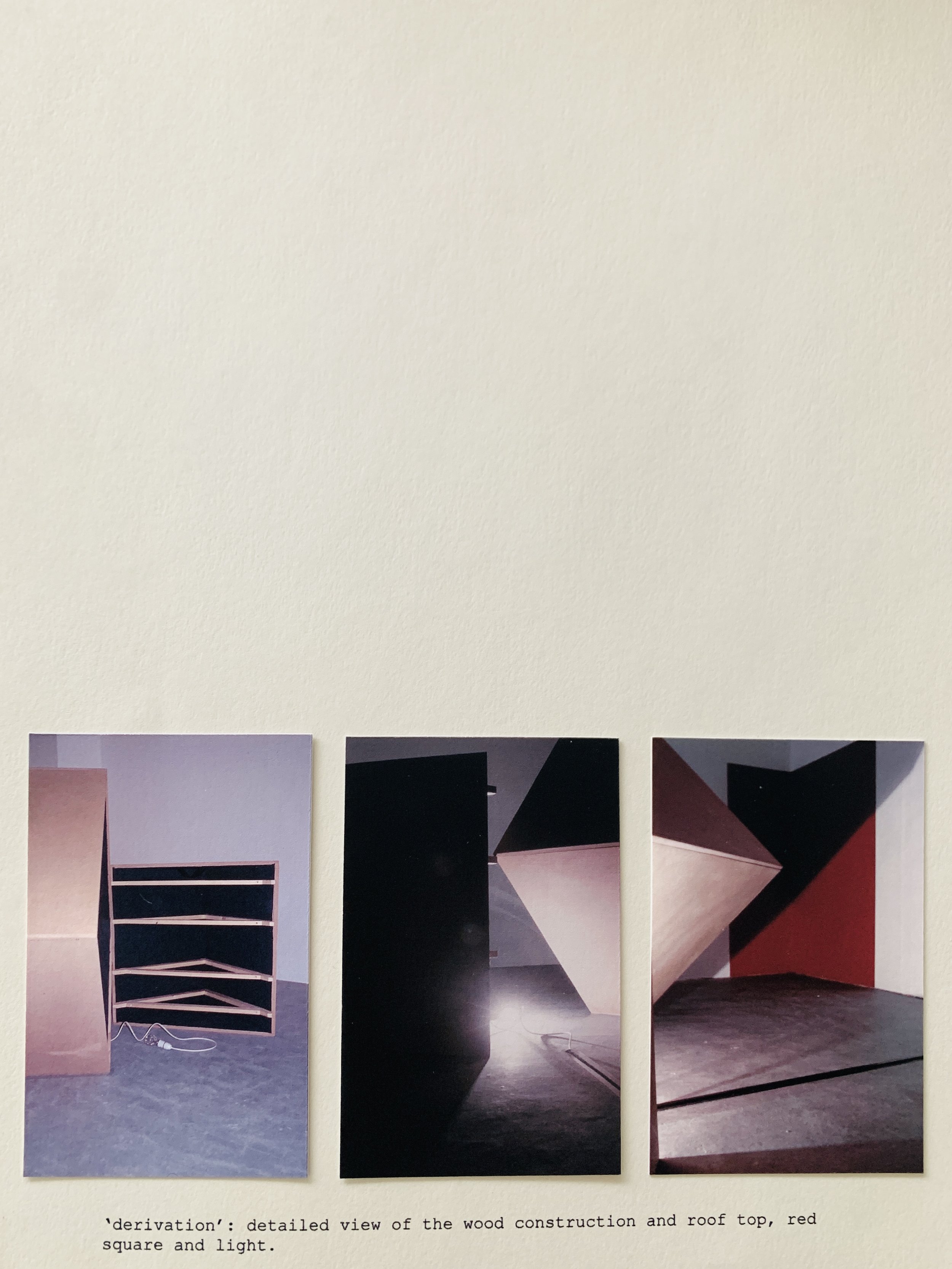
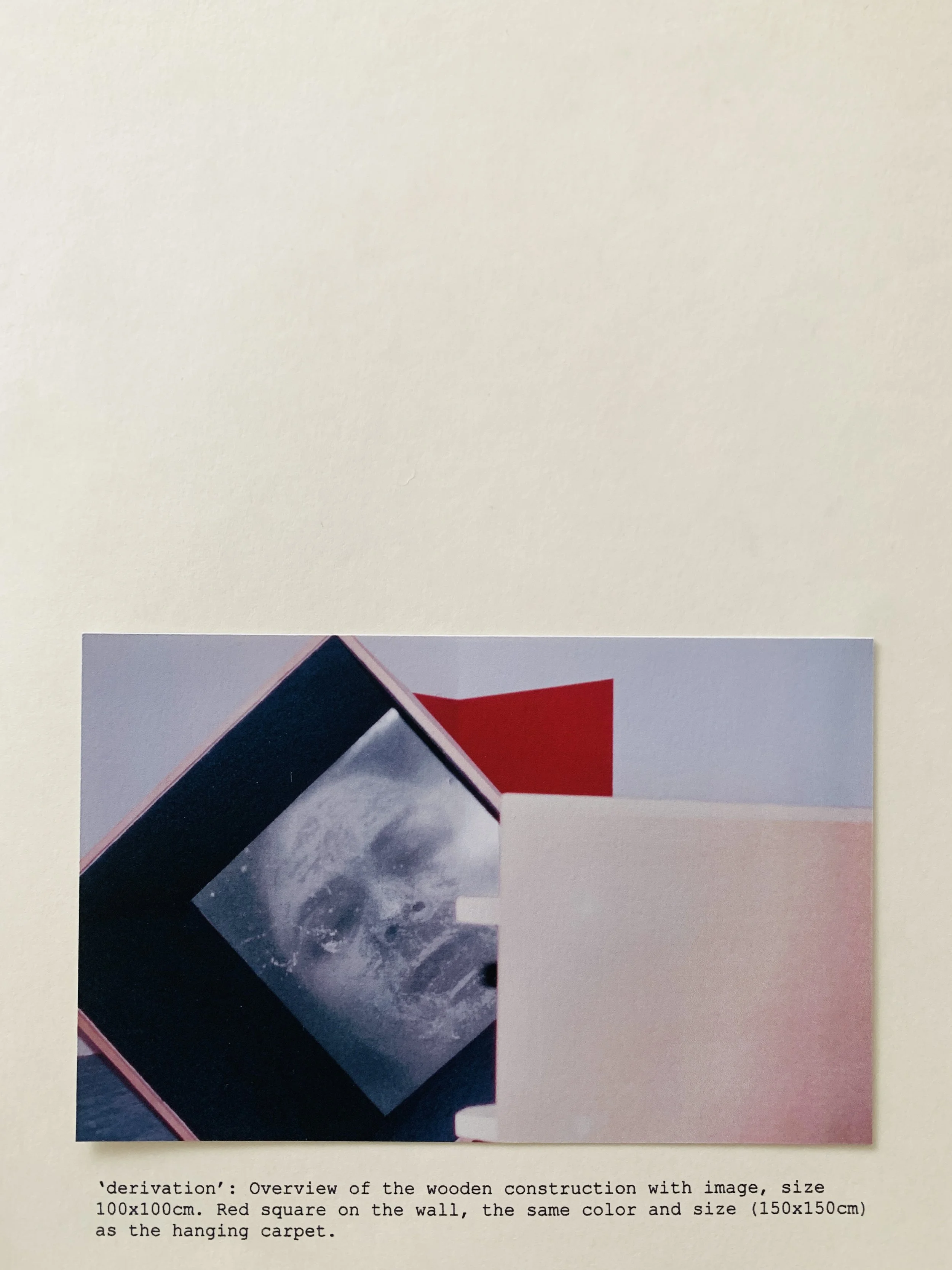
Both materials and concepts connect the pieces, as each occupies the home of intimacy, the area of the floor, and the relations between these. The thematic concern of the work is based on an internal sense of emotional space, touching on the idea of a pre-existing and somehow innate emptiness sometimes experienced within existence, sometimes lying dormant like the photograph beneath the water.
By placing the work in two installation rooms—divided yet connected—I hoped to enable an experience that would operate laterally and evoke associative thinking in the viewer.
©️ Camilla Howalt
NEST WEIGHT 3/3 (2001)
𝑺𝒆𝒓𝒊𝒂𝒍 𝑺𝒄𝒖𝒍𝒑𝒕𝒖𝒓𝒆
Bronze / Fishing Thread (70-100 Denier)
Diameter of 40 mm
Three hand-polished bronze spheres, each stamped with serial numbers and initials, tightly wrapped in lengths of fine, translucent fishing thread (70–100 denier). At first glance, they appear delicate - like small nests or cocoons, barely there. But when held, their unexpected weight interrupts the illusion.
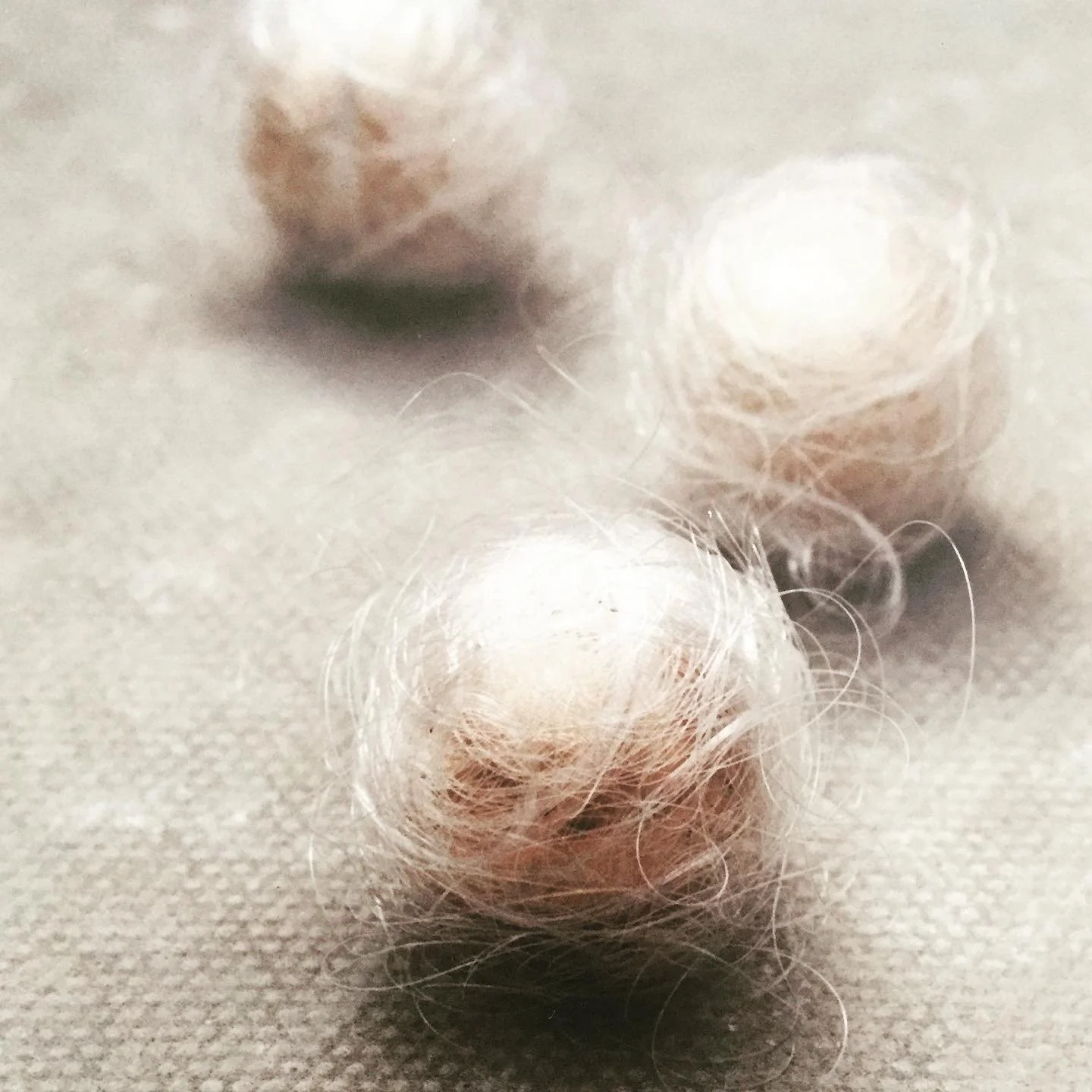
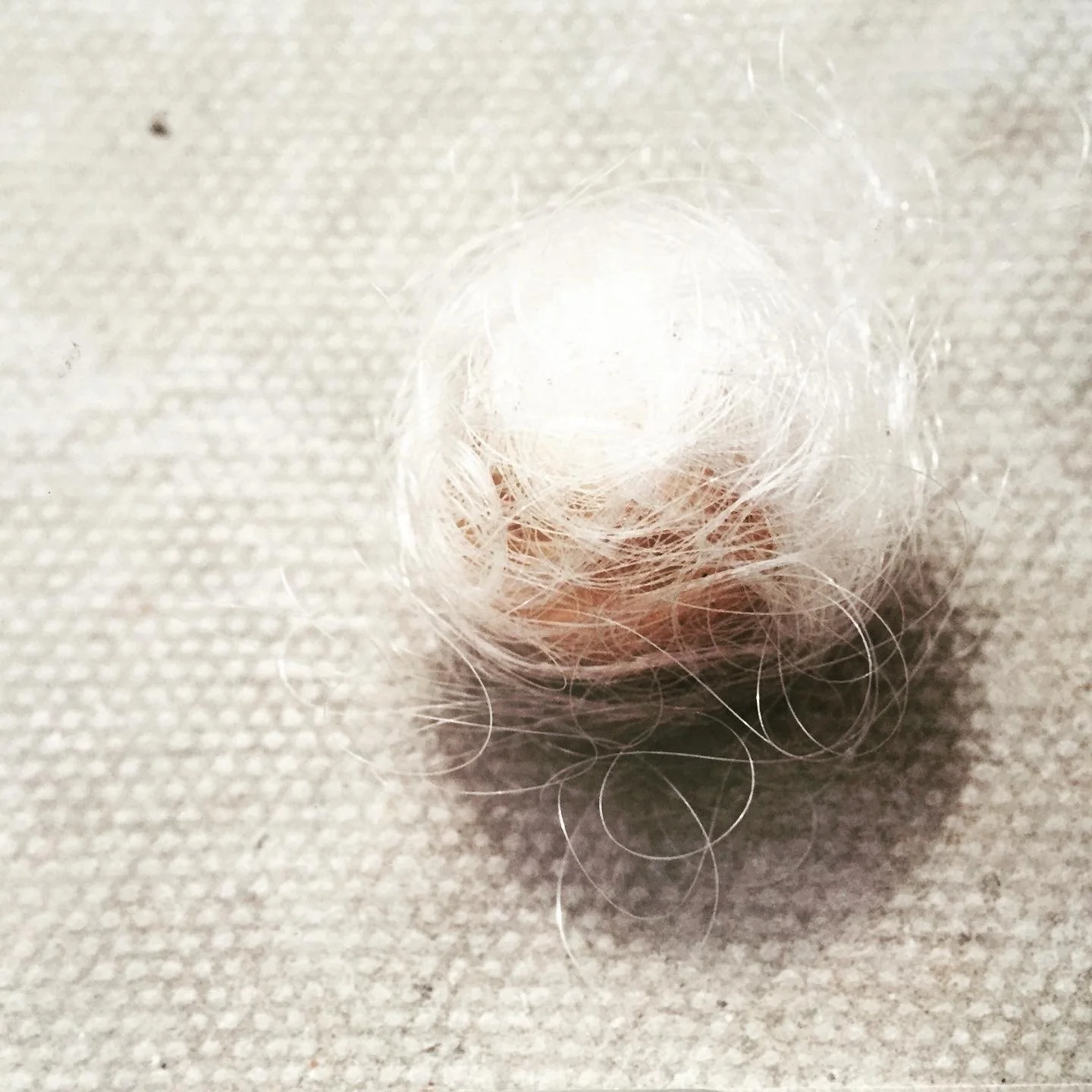
Made to be touched, not just seen, these intimate sculptures stage a quiet conflict between perception and sensation. What seems soft is dense. What looks fragile is solid. The thread does not cradle but cocoons - an act of containment as much as concealment. Beneath the apparent chaos of the thread’s layers lies a hidden structure, revealing an underlying order in what might first appear tangled or disorderly.
Each sphere is held in different private collections in England.
©️ Camilla Howalt